Short Communications
Vol. 39 No. 1-2 (2026)

Range extension of the Nahan’s partridge (Ptilopachus nahani) in Cameroon evidenced by camera traps
Publisher's note
All claims expressed in this article are solely those of the authors and do not necessarily represent those of their affiliated organizations, or those of the publisher, the editors and the reviewers. Any product that may be evaluated in this article or claim that may be made by its manufacturer is not guaranteed or endorsed by the publisher.
Published: 4 March 2026
125
Views
2
Downloads

Authors

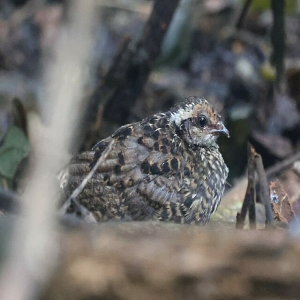
Nahan’s Partridge Ptilopachus nahani is a lowland forest bird species, classified as Vulnerable. This study reports new camera trap detections in southeastern Cameroon, suggesting a potential westward range extension of over 1,000 km, given that the nearest known population is located in western Uganda. Between May 2016 and December 2023, six detection events confirmed the presence of at least nine distinct individuals within semi-deciduous logged forests. These findings highlight the need to update distribution maps and conservation strategies for this vulnerable species. Future ecological and genetic studies are essential to clarify the species’ full range, assess population connectivity, and guide conservation efforts.

Downloads

Download data is not yet available.

Citations

Blervacq R. 2023. Interactions trophiques entre mammifères et espèces ligneuses d’intérêt commercial dans une forêt du sud-est Cameroun. Master’s Thesis. University of Liège, Gembloux Agro-Bio Tech, Belgium. 74 pp. http://hdl.handle.net/2268.2/18291
BirdLife International. 2017. Ptilopachus nahani. The IUCN Red List of Threatened Species 2017: e.T22678795A118416398. https://doi.org/10.2305/IUCN.UK.2017-3.RLTS.T22678795A118416398.en
Bourgoin C, Verhegghen A, Degreve L, Ameztoy I, Carboni S, Colditz R, Achard F. 2024. Global map of forest cover 2020 - version 2. European Commission, Joint Research Centre (JRC). http://data.europa.eu/89h/e554d6fb-6340-45d5-9309-332337e5bc26. (accessed on 28 Mai 2025)
Cordier CP, Ehlers Smith DA, Ehlers Smith Y, Downs CT. 2022. Camera trap research in Africa: A systematic review to show trends in wildlife monitoring and its value as a research tool. Global Ecology and Conservation. 40:e02326. https://doi.org/10.1016/j.gecco.2022.e02326
Fick SE, Hijmans RJ. 2017. WorldClim 2: New 1-km spatial resolution climate surfaces for global land areas. International Journal of Climatology. 37(12):4302–4315. https://doi.org/10.1002/joc.5086
Fonteyn D, Fayolle A, Orbell C, Malignat R, Cornélis D, Vanthomme H, Vigneron P, Vermeulen C. 2022. Range extension of the agile mangabey (Cercocebus agilis) and of the mandrill (Mandrillus sphinx) in eastern Gabon evidenced by camera traps. African Journal of Ecology. 60(4):1267–1270. https://doi.org/10.1111/aje.13061
Houngbégnon FGA, Gillet JF, Michaux J, Brostaux Y, Zébazé D, Lhoest S, Vermeulen C, Sonké B, Doucet JL. 2023. Seed dispersal by duikers in selectively logged rainforests: Overlooked dispersal of an important animal community. Forest Ecology and Management 529:120650. https://doi.org/10.1016/j.foreco.2022.120650
Lowe WH, Allendorf FW. 2010. What can genetics tell us about population connectivity? Molecular Ecology. 19(15):3038–3051. https://doi.org/10.1111/j.1365-294X.2010.04688.x
Pavlacky Jr DC, Goldizen AW, Prentis PJ, Nicholls JA, Lowe AJ. 2009. A landscape genetics approach for quantifying the relative influence of historic and contemporary habitat heterogeneity on the genetic connectivity of a rainforest bird. Molecular Ecology. 18(14):2945–2960. https://doi.org/10.1111/j.1365-294X.2009.04226.x
Réjou-Méchain M, Mortier F, Bastin J-F, Cornu G, Barbier N, Bayol N, Bry X, Bénédet F, Dauby G, Deblauwe V, et al. 2021. Unveiling African rainforest composition and vulnerability to global change. Nature. 593(7857):90–94. https://doi.org/10.1038/s41586-021-03483-6
Ruiz-García M, Castellanos A, Kaston F, Pinedo-Castro M, Shostell, JM. 2024. New insights into the molecular evolution of Tapirus pinchaque (Tapiridae, Perissodactyla) and the rise and fall of Tapirus kabomani as a full species. Genes (Basel). 15:1537. https://doi.org/10.3390/genes15121537
Sande E, Dranzoa C, Wegge P, Carroll JP. 2009. Home ranges and survival of Nahan’s Francolin Francolinus nahani in Budongo Forest, Uganda. African Journal of Ecology. 47:457–462. https://doi.org/10.1111/j.1365-2028.2008.00990.x
Sande E, Akoth S, Rutazaana U, Olupot W. 2020. Status of Nahan’s Partridge Ptilopachus nahani (Dubois, 1905) (Aves: Galliformes: Odontophoridae) in Uganda. Journal of Threatened Taxa. 12:17063–17076. https://doi.org/10.11609/jott.5343.12.15.17063-17076
Tossens S, Drouilly M, Woodgate Z, Ruwet M, Vanderbeck E, Lhoest S, Vermeulen C, Kehou ST, Doucet J-L. 2025. Humans acting as ‘super predators’ in Central African forests: trophic erosion and disruption of predator-prey dynamics. Presentation at: Tropical Biology and Conservation for a Sustainable World: Merging Diverse Approaches, Actors, and Local Knowledge. Oaxaca, Mexico (30.VI.2025). https://orbi.uliege.be/handle/2268/335381
Zwerts JA, Sterck EHM, Verweij PA, Maisels F, van der Waarde J, Geelen EAM, Tchoumba GB, Donfouet Zebaze HF, van Kuijk M. 2024. FSC-certified forest management benefits large mammals compared to non-FSC. Nature. 628(8008):563–568. https://doi.org/10.1038/s41586-024-07257-8

Supporting Agencies

Programme de Promotion de l'Exploitation Certifiée des Forêts (PPECF), Fonds pour la Formation à la Recherche dans l’Industrie et dans l’Agriculture (FRIA)

How to Cite


Range extension of the Nahan’s partridge (Ptilopachus nahani) in Cameroon evidenced by camera traps. (2026). Tropical Zoology, 39(1-2). https://doi.org/10.4081/tz.2026.225